Everyone wants autonomous agents.
That is the wrong starting point.
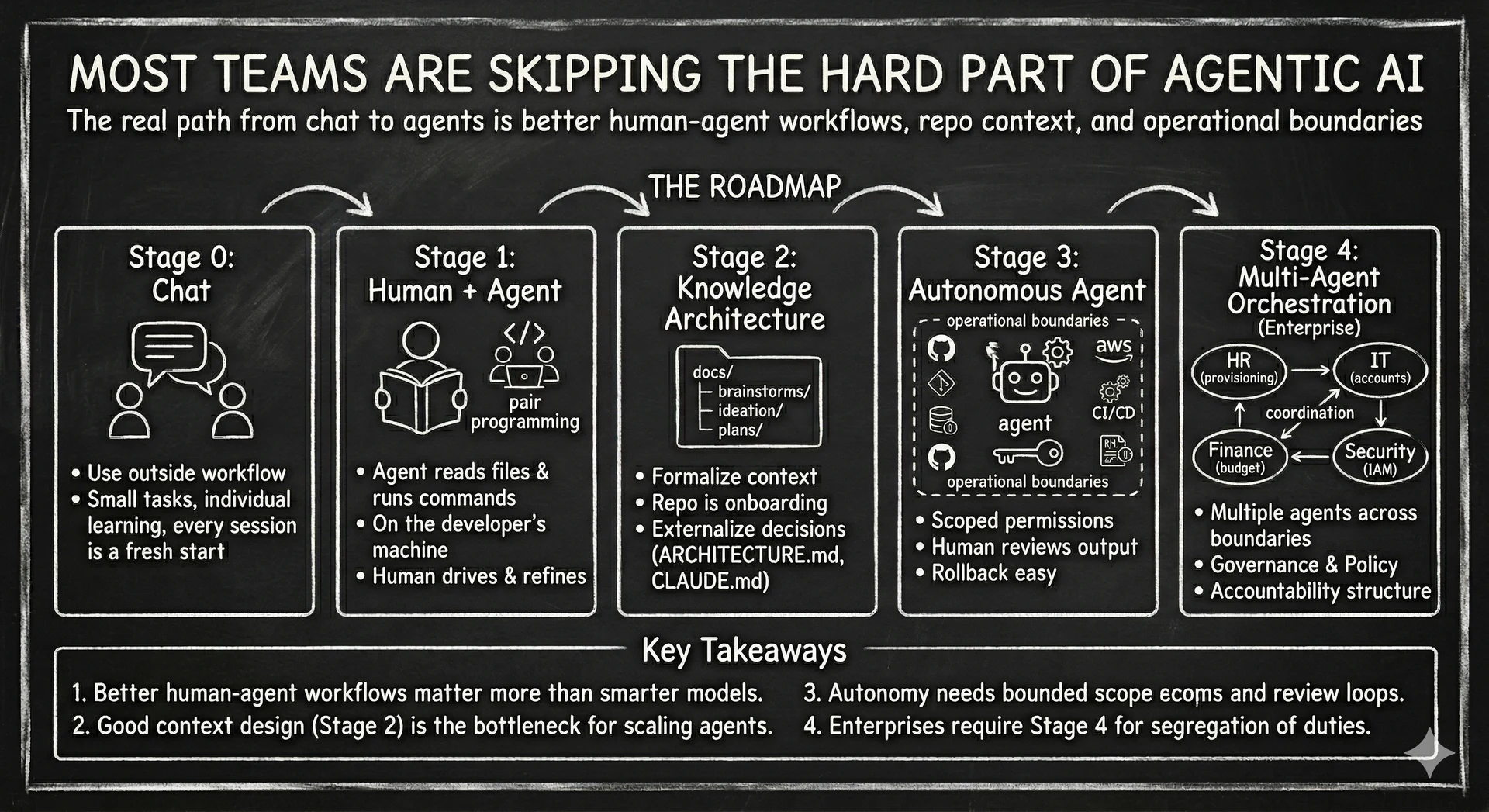
Most companies using AI today are somewhere between Stage 0 and Stage 1: asking questions in chat, generating snippets, or using agents in their IDEs but still treating AI as a tool that lives alongside the workflow, not inside it. The temptation is to jump from there to "fully autonomous agents." But in practice, that jump usually fails.
Not because the models are too weak.
Because the company is not ready.
Agents do not fail only from bad reasoning. They fail from bad context, unclear ownership, weak review loops, missing documentation, and systems that were never designed to be legible to anything except the people who already work there.
So the real roadmap is not "chat, then autonomy." It is:
- Learn to work with an agent inside the workflow
- Make your repo and decisions readable to the agent
- Introduce bounded autonomy
- Only then consider multi-agent orchestration
That is the path most teams should follow. Not every company needs multi-agent orchestration. Every company needs steps 1 and 2.
GenAI vs. Agentic AI
The underlying models are the same. The difference is tool access and autonomy.
GenAI: you give it input, it gives you output. It writes your email, summarizes your doc, generates code. It's powerful. Millions of people get real value from it daily. But it lives in a box. You are the hands and feet. You copy the output, switch to the right tool, and apply it yourself.
An agent has hands and feet. It can act on your environment. It reads your files, runs commands, hits APIs, observes the results, adjusts, and keeps going.
You can ask it the same question — "why is this test failing?" — but the difference is what happens next. Without an agent, you copy the error, paste it into a chat, get a guess based on the error message alone, then go back and copy more context (the test file, the function, the recent diff) and go back and forth narrowing it down. You're the one assembling the picture.
With an agent, it reads the error, checks the git log, looks at what changed recently, reads the diff, and comes back with: "this test is failing because yesterday's PR changed the response schema but didn't update the assertion." It assembled the context itself.
The jump from chat to agent isn't smarter AI. It's giving AI the ability to act.
The Stages
Stage 0: Chat
Use AI outside the workflow for drafts, explanations, and isolated help.
What it looks like: Prompts, copy-paste, one-shot code generation. ChatGPT, Claude, Gemini, Grok — everyone's using them for email drafting, summarizing docs, brainstorming, explaining concepts.
What it's good for: Speed on small tasks. Building AI literacy.
What it doesn't do: Accumulate context or improve team throughput. Every interaction starts from zero. The human is the integration layer.
Why teams get stuck here: The model helps individuals, but the organization learns nothing. There's no feedback loop. No compounding. Every session is a fresh start.
Stage 1: Human + Agent
Put the agent on the developer's machine and let it operate inside the real loop.
What changes: The agent can read files, run commands, inspect the codebase, and work interactively. It uses the engineer's own credentials — it sees what they see, nothing more.
What the human owns: Task framing, approvals, judgment, and correction. The human drives. The agent executes.
Why this matters: This is where teams learn the craft of agent collaboration. Not through a training program, but through repeated use inside the real workflow. Teams start with existing skills, adapt them to their context, and gradually build new ones. Over time, both the skills and the team's judgment improve.
The craft feedback loop: It's not just the skills that improve. The team gets better at working with agents, and that knowledge compounds through repeated use, shared practice, and iteration — not through formal training.
Common mistake: Assuming better models matter more than better operator habits. The team that learns to frame problems well, review agent output carefully, and build reusable skills will outperform the team with a bigger model budget every time.
What breaks if you skip ahead: Without the craft of working with agents — without learning when to trust, when to verify, when to reframe — jumping to autonomy means giving an unsupervised agent the authority to act on a codebase it doesn't understand, directed by humans who haven't learned how to direct it.
Exit criteria for Stage 2: The team has working skills shared via Git. Multiple engineers are using agents daily. People are naturally sharing tips and refining workflows. You're ready to formalize what you've learned.
Stage 2: Knowledge Architecture
Turn tribal knowledge into durable context the agent can actually use.
This is the stage most teams underestimate. And the one that matters most.
If your architecture decisions live in people's heads, scattered Slack threads, and undocumented conventions, your agent is working blind. The answer is not more prompting. It is better context design.
What changes: The team formalizes how context gets created, structured, and maintained, so that both humans and agents can operate with full context from day one. The repo stops being just source code. It becomes onboarding for both humans and agents.
What the human owns: Context quality. Deciding what gets documented, what structure it follows, what the conventions are. The human is the architect of the system the agent operates in.
That means:
- Architecture docs that explain how the system fits together
- Implementation plans with structured frontmatter, linked to PRs
- Decision records that capture the why, not just the what
- Explicit repo-level agent instructions — for example
CLAUDE.md, a markdown file the agent reads at the start of every session, setting coding standards, architecture decisions, and review checklists - Shared conventions for how work gets done
What a Stage 2 repo looks like
docs/
├── brainstorms/      ← Raw thinking. "We might need X."
├── ideation/         ← Shaped thinking. Structured enough to evaluate.
├── plans/            ← Committed decisions. Linked to PRs.
├── ARCHITECTURE.md   ← How the system fits together
└── DEPLOYMENT_ARCHITECTURE.md
CLAUDE.md             ← Agent entry point. Rules of engagement.
An agent dropping into this repo for the first time can read CLAUDE.md, understand the rules of engagement, browse docs/plans/ to see the history of decisions, check ARCHITECTURE.md to understand how the system fits together. The repo is the onboarding. No two-hour walkthrough needed.
The self-reinforcing loop
Plan doc → PR → CLAUDE.md references the plans folder → next agent reads the plans → understands patterns → produces work following the same conventions → creates its own plan doc. Every plan doc makes the next agent interaction better.
Multi-model review
The plan docs aren't just for humans and agents. They're the artifact you run through multiple frontier models for review before you write a single line of code. Every model has biases shaped by how it was built. Cross-checking a plan across different model families catches blind spots that any single model would miss. Without structured plan docs, there's nothing to review.
What breaks if you skip ahead: Without externalized context, an agent has tool access but zero understanding. It doesn't know that changing the auth service affects the billing pipeline, or that the queue config is tied to three downstream consumers. It doesn't know why something was built a certain way, or what will break where. It's like hiring a contractor, handing them repo access, and saying "figure it out."
Exit criteria for Stage 3: Your repo is self-describing. New humans and new agent sessions can get full context from the repo alone. Architecture decisions are documented. Plan docs have structured frontmatter. Conventions are explicit, not implicit.
When Context Is Missing: A Real Failure
Here is what happens when a team tries to skip Stage 2.
An agent was tasked with fixing a visual alignment issue on a production site. The codebase had no architecture doc, no CSS conventions, no documentation of why the existing approach used specific layout techniques.
The agent tried a reasonable fix: absolute positioning with overflow clipping. It looked right in the first test. But it broke the baseline alignment of adjacent elements. So the agent tried another variation — same approach, different values. Still broken. It iterated six more times, each attempt a variation of the same class of approach, each one looking plausible, each one failing for the same underlying reason.
The reason: a CSS spec detail. overflow: hidden on an inline-block element forces the baseline to the bottom margin edge. The agent didn't know this because it wasn't in the codebase, and the spec detail was obscure enough that the model's training data didn't surface it reliably.
After seven failed attempts, the team escalated to a second model. That model gave the answer in one round: use a phantom anchor element to hold the baseline, animate the visible element with translateY in the same grid cell. Problem solved.
What would Stage 2 have prevented? Three things:
- A
CLAUDE.mdrule: "After 2-3 failed attempts at the same class of approach, stop and consult a second model." The agent burned seven attempts when the stop-and-escalate policy should have kicked in at three. - A CSS conventions doc: Documenting that the layout used specific inline-block baseline behavior would have given the agent the context it needed on the first attempt.
- Multi-model review at the plan stage: Running the approach through a second model before seven iterations would have surfaced the spec issue immediately.
Seven iterations that each looked correct. Each one failed for the same reason. No one told the agent what it was missing, because no one had written it down. That is the skip problem in action.
Stage 3: Autonomous Agent
The agent operates off the machine. The human supervises.
But bounded is the key word.
The agent gets deployed on its own infrastructure. It's no longer tethered to a developer's laptop session. It has access to the same tools as Stage 1 — GitHub, AWS, CI/CD, monitoring, error logs — but no human is actively driving. It picks up tasks, executes against the codebase, creates PRs, flags issues, connects errors to root causes.
This only works because of Stages 1 and 2. Stage 1 gave it battle-tested skills refined through human feedback loops. Stage 2 gave it a self-describing codebase where the context is discoverable.
What changes: The agent operates independently within defined boundaries. It has its own credentials, scoped to what it needs (least privilege). The human reviews output — PRs, reports, escalations.
What the human owns: Approval authority, problem framing, tradeoff decisions, accountability for outcomes. The human moves from driver to reviewer. As autonomy increases, the human shifts from driver to reviewer — from executing each step to setting boundaries, judging output, and owning the result.
What this looks like in practice: We run this today. As of March 2026, our production app ships about 30 deploys a month with a two-person team and two AI agents. The humans push to main. The agents open PRs. Every agent PR gets human review before merge. Average cycle time from PR open to production: 13.5 minutes.
Autonomy should be introduced only where:
- Scope is clear
- Permissions are constrained
- Review points exist
- Rollback is easy
- Auditability is real
What breaks if you skip ahead: The agent makes changes that look correct but silently break things downstream. Changes work in isolation but violate patterns and break dependencies nobody told the agent existed. The codebase degrades in ways that compound over time. Most failed agent rollouts don't fail because the model was bad. They fail because the company skipped Stages 1 and 2.
For smaller orgs, this may be the endgame. A well-scoped agent with good permissions, running autonomously, human reviewing output. Not every company needs what comes next.
Who Should Not Use Stage 3 Yet
Do not introduce autonomous coding agents yet if:
- Your team does not review AI-generated code carefully. If agent PRs get rubber-stamped, you're accumulating unreviewed changes in production.
- Your repo lacks current documentation. No
CLAUDE.md, no architecture doc, no plan history? The agent is operating blind. - Architecture decisions are mostly implicit. If "everyone just knows" how the system works, the agent doesn't know.
- Your testing and deployment process is fragile. If a bad merge doesn't get caught or it takes an hour to ship a fix, you can't afford an unsupervised agent shipping changes.
- Rollback is painful. Autonomy requires fast, safe recovery. If you don't have that, don't add an autonomous actor.
- No one has defined what the agent is allowed to do without approval. If there's no explicit scope, every action is a judgment call with no guardrails.
In that case, stay in Stage 1 and Stage 2 longer. That is not a failure. That is maturity. The companies that succeed with autonomous agents are the ones that spent enough time in the earlier stages that the transition was boring, not dramatic.
Stage 4: Multi-Agent Orchestration (Enterprise)
Multiple agents coordinate across organizational boundaries.
Only a subset of companies need this.
This stage exists because enterprise workflows cross permission boundaries that shouldn't be collapsed. Why does HR have different access than Infrastructure? Why can't Finance modify production? Because segregation of duties exists for compliance, security, and accountability reasons. The same logic applies to agents.
The value is not "more agents." The value is controlled coordination across boundaries.
Example — new hire onboarding:
- HR agent triggers provisioning (has access to employee PII)
- IT agent creates accounts and sets up machines (has access to identity systems)
- Finance agent allocates budget and approves spend (has access to financial systems)
- Security agent sets access policies based on role (has access to IAM)
Four domains. Four permission scopes. Four compliance boundaries. A single agent with all those permissions is a security incident waiting to happen.
What's required: Service identities for each agent scoped to their domain, an agent registry, cross-agent communication protocols, full audit trail on every handoff, governance policies for what decisions require human approval, and an accountability model for autonomous decisions.
What the human owns: Governance. Policy. Accountability structure. The human defines the boundaries — the agents coordinate within them.
Who needs Stage 4: Enterprises with segregation of duties. Companies large enough that cross-team workflows involve different security domains. Not a 20-person startup.
Foundation Layer
The stages above only work if a few baseline conditions are already in place:
1. Enterprise agreements with model providers. Data isn't used for training. The legal side is covered. BAAs, DPAs, data residency as required. You should have access to multiple model families, not just one. Monoculture in models creates the same risk as monoculture in anything else.
2. Multi-model review as a practice. Every model has biases shaped by how it was built. Cross-check plans and approaches across multiple frontier models before you write code. The cheapest bug to fix is the one you catch at the design stage. The plan docs from Stage 2 are the artifact you run through multiple models for review.
3. Team agreement on AI use. What goes into prompts, what doesn't. How AI-generated output gets reviewed. What level of autonomy the team is comfortable with today. This doesn't need to be heavy. It needs to exist.
Where the Human Sits
The human does not disappear as autonomy increases. The human moves.
At first, the human is doing most of the work and using AI for assistance. Later, the human becomes: the problem framer, the reviewer, the approver, the owner of tradeoffs, the person accountable for the outcome.
That shift matters. Good teams do not remove humans from the loop. They move humans to the highest-leverage parts of the loop.
| Stage | Human Role | Agent Role | Relationship |
|---|---|---|---|
| Stage 0 | Does the work | Answers questions | You ask, it talks |
| Stage 1 | Drives and refines | Executes on the machine | Pair programming |
| Stage 2 | Builds the system | Operates within the system | Way-of-working shift |
| Stage 3 | Reviews output | Operates independently | Supervision |
| Stage 4 | Sets governance | Agents coordinate | Policy-driven |
The Real Risk
The question is not whether autonomous agents are coming. They are.
The real question is which companies will be able to use them without creating invisible operational debt.
The winners will not be the teams with the most aggressive agent demos. They will be the teams that learned how to collaborate with agents, built context into their systems, and introduced autonomy only after the surrounding workflow could support it.
Because the real risk is not that agents fail loudly. It is that they appear to work while quietly making the system harder to understand, harder to trust, and harder to change.
That is the mistake most teams will make.
The teams that win will be the ones that prevent that debt from forming in the first place.
Sanjeev Nithyanandam is the founder of Accelra Technologies, an agentic engineering consultancy in Vancouver. Follow the journey at Ship With Sanjeev.